
What's This Book For?
The Bible isn’t just a revelation of His will, rather, it is a revelation of God Himself! The way God reveals His will is through a revelation of His character. How does God reveal His character? The answer is not just intellectually but experientially. We understand God by experiencing Him in our lives, better still, by having the indwelling life of Christ displace our own. We learn about God as He abides with us in the person of the Holy Spirit.
What’s This Book For?
Why has the Bible been handed down to us in its present form? Fundamental belief #1 of the SDA Church reads as follows:
The Holy Scriptures, Old and New Testaments, are the written Word of God, given by divine inspiration through holy men of God who spoke and wrote as they were moved by the Holy Spirit. In this Word, God has committed to man the knowledge necessary for salvation. The Holy Scriptures are the infallible revelation of His will. They are the standard of character, the test of experience, the authoritative revealer of doctrines, and the trustworthy record of God's acts in history. (2 Peter 1:20, 21; 2 Tim. 3:16, 17; Ps. 119:105; Prov. 30:5, 6; Isa. 8:20; John 17:17; 1 Thess. 2:13; Heb. 4:12.)
“The infallible revelation of his will, committing to man the knowledge necessary for salvation” That’s what we as SDA’s believe. But what is the knowledge necessary for salvation? Jesus makes a plain statement in this regard in John 17: ESV) 1 When Jesus had spoken these words, he lifted up his eyes to heaven, and said, “Father, the hour has come; glorify your Son that the Son may glorify you, 2 since you have given him authority over all flesh, to give eternal life to all whom you have given him. 3 And this is eternal life, that they know you the only true God, and Jesus Christ whom you have sent. 4 I glorified you on earth, having accomplished the work that you gave me to do.
So the Bible isn’t just a revelation of His will, rather, it is a revelation of God Himself! The way God reveals His will is through a revelation of His character. How does God reveal His character? The answer is not just intellectually but experientially. We understand God by experiencing Him in our lives, better still, by having the indwelling life of Christ displace our own. We learn about God as He abides with us in the person of the Holy Spirit.
The Bible itself makes it clear that the revelation of God in scripture is part of a progressive unveiling.
Hebrews 1 (NKJV) (God’s Supreme Revelation) 1 God, who at various times and in various ways spoke in time past to the fathers by the prophets, 2 has in these last days spoken to us by His Son, whom He has appointed heir of all things, through whom also He made the worlds; 3 who being the brightness of His glory and the express image of His person, and upholding all things by the word of His power, when He had by Himself purged our sins, sat down at the right hand of the Majesty on high,4 having become so much better than the angels, as He has by inheritance obtained a more excellent name than they.
Colossians 1: (NKJV) 15 He is the image of the invisible God, the firstborn over all creation. 16 For by Him all things were created that are in heaven and that are on earth, visible and invisible, whether thrones or dominions or principalities or powers. All things were created through Him and for Him. 17 And He is before all things, and in Him all things consist. 18 And He is the head of the body, the church, who is the beginning, the firstborn from the dead, that in all things He may have the preeminence.
The Bible reveals that there is no clearer portrayal of the Father than in the person of His Son, so by necessity we must conclude that some parts of scripture do not reveal God as clearly as others. Now why is this? We as SDA’s understand the scripture to be thought-inspired, in other words, God inspired men to write, giving them ideas, but the words they used and the composition of them is their own. The Bible, like Jesus, is a miraculous combination of the human and the divine. Ellen White expresses it this way:
“The Bible is written by inspired men, but it is not God’s mode of thought and expression. It is that of humanity. God, as a writer, is not represented. Men will often say such an expression is not like God. But God has not put Himself in words, in logic, in rhetoric, on trial in the Bible. The writers of the Bible were God’s penmen, not His pen. Look at the different writers.” {1 Selected Messages 21.1}
It is not the words of the Bible that are inspired, but the men that were inspired. Inspiration acts not on the man’s words or his expressions but on the man himself, who, under the influence of the Holy Ghost, is imbued with thoughts. But the words receive the impress of the individual mind. The divine mind is diffused. The divine mind and will is combined with the human mind and will; thus the utterances of the man are the word of God.—Manuscript 24, 1886 (written in Europe in 1886).{1 Selected Messages 21.2}
Consequently, we need the Holy Spirit to discern the scriptures just as much as those men of old needed Him to write them. Again, Ellen White cautions us to hold our views very lightly when it comes to offering our opinions on what the Bible teaches.
“We have many lessons to learn, and many, many to unlearn. God and heaven alone are infallible. Those who think that they will never have to give up a cherished view, never have occasion to change an opinion, will be disappointed. As long as we hold to our own ideas and opinions with determined persistency, we cannot have the unity for which Christ prayed.” {Counsels to Christian Writers and Editors, Page 37, paragraph 1}
I remember a morning devotional Pastor Carlos Ancheta gave at campmeeting some years ago entitled “Treasure Hunters”. He was speaking from the text in Matthew 13: (ESV) 44 “The kingdom of heaven is like treasure hidden in a field, which a man found and covered up. Then in his joy he goes and sells all that he has and buys that field. From his study the Pastor concluded something that I found quite fascinating; the field, he said, represents the word of God and the treasure, the Gospel. Because I wasn’t sure if he fully realized the implications of that statement and I wanted to confirm it, I went and spoke with the pastor afterwards. What composes a field I asked him?...a lot of dirt. The Bible is not a sanitized book, it’s messy and painful and sometimes it doesn’t reflect God very well. As we continued our conversation, I asked him the question “what if we are willing to make scripture our study and science, to dig down below the surface” and we both answered in unison “God will reveal Himself”. It was at that point I knew we were in complete agreement and I had understood him correctly
That morning, before I heard the pastor speak, I had just finished reading Joshua Chapter 10. If you’re not familiar with that chapter, Joshua and the tribes of Israel had just conquered the King of Ai and made subjects of the Gibeonites. When the king of Jerusalem hears this he makes a pact with four other kings of the Amorites to attack the Gibeonites because they are in league with Israel. Then Gibeon calls Israel to come to their aid. Israel responds and completely routes the Amorites. The story tells us that “the Lord threw down large stones from heaven on them as far as Azekah, and they died. There were more who died because of the hailstones than the sons of Israel killed with the sword.”
The kings of the Amorites are forced to flee and they find refuge in a cave. They are eventually found and Joshua instructs his men to put large stones in front of the mouth of the cave so that they cannot escape until the mopping up operation of the Amorite armies. Then Joshua brings the five kings out of the cave and executes them on the spot. Next, the Israelite army undertakes to visit each of the cities represented by these kings and systematically exterminates their entire populations. These are the kind of verses unbelievers point to when we suggest our God is a God of love. How can He be, they ask, when He endorses genocide and ethnic cleansing? I have asked myself why these kinds of stories are even in the Bible. How can we begin to reconcile these pictures of God with the way Jesus describes Him in the Gospels? How can the God who condones such violence be the same God who says: Matthew 5: (ESV) 43 “You have heard that it was said, ‘You shall love your neighbor and hate your enemy.’44 But I say to you, Love your enemies and pray for those who persecute you, 45 so that you may be sons of your Father who is in heaven. For he makes his sun rise on the evil and on the good, and sends rain on the just and on the unjust. 46 For if you love those who love you, what reward do you have? Do not even the tax collectors do the same? 47 And if you greet only your brothers, what more are you doing than others? Do not even the Gentiles do the same? 48 You therefore must be perfect, as your heavenly Father is perfect.
Jesus tried to get His disciples to see a radical picture of God not as one who’s out to destroy men’s lives but as one who strives to reconcile and redeem mankind. Remember when Jesus was requesting to pass through a Samaritan village and He and His disciples were refused entry. His disciples were indignant: Luke 9: (NKJV) 54 And when His disciples James and John saw this, they said, “Lord, do You want us to command fire to come down from heaven and consume them, just as Elijah did?” 55 But He turned and rebuked them, and said, “You do not know what manner of spirit you are of. 56 For the Son of Man did not come to destroy men’s lives but to save them.” And they went to another village.
So back to our original point; there are parts of the Bible that reveal God more clearly than others. The Bible was written by men who were struggling to understand, wrestling with the evidence of their circumstances, just to get a glimpse of God, just as we do. Even Jesus in the Gospels was not able to reveal God as clearly as He would have liked. That is not due to any lack on His part but because the people He was addressing, His audience at the time, were not ready for the full truth. Are we? John 16: (ESV) 12 “I still have many things to say to you, but you cannot bear them now. 13 When the Spirit of truth comes, he will guide you into all the truth, for he will not speak on his own authority, but whatever he hears he will speak, and he will declare to you the things that are to come.
So it logically leads to the question: are there things Jesus would like to reveal to us today that the Holy Spirit cannot disclose because we are not ready? Certainly, the Book of Revelation penned by the apostle John some years after the Lord’s resurrection, was a further revelation than when Jesus was present on earth. We might even ask…”is that all there is?” The prophet Joel reveals: Joel 2: (ESV)28 “And it shall come to pass afterward, that I will pour out my Spirit on all flesh; your sons and your daughters shall prophesy, your old men shall dream dreams, and your young men shall see visions. Is the Holy Spirit not still working today? Will there be more revealed about God in the last days? According to Ellen White, there is: Those who wait for the Bridegroom’s coming are to say to the people, “Behold your God.” The last rays of merciful light, the last message of mercy to be given to the world, is a revelation of His character of love. The children of God are to manifest His glory. In their own life and character they are to reveal what the grace of God has done for them. {Christ's Object Lessons 415.5}. Is the Gospel message that we proclaim a revelation of God’s character of love? Are we proclaiming the Gospel in truth as it is in Jesus? If not, we need to adjust our thinking and our message, both individually and as the body of Christ.
In that morning devotional, Pastor Ancheta asked the question: “Why is the treasure buried”? Of course the answer is: because it just is, that’s the reality. God would make it plain for us if He could, be we have buried it under a lot of misinformation and misunderstanding about Him. But if we truly desire to know God (John 17) we will find the treasure. Jeremiah 29: (NKJV) 12 Then you will call upon Me and go and pray to Me, and I will listen to you. 13 And you will seek Me and find Me, when you search for Me with all your heart. 14 I will be found by you, says the Lord, and I will bring you back from your captivity; Did you catch that…”when you search for Me with all your heart”. God wants us to uncover the treasure, He’s longing for us to find it, but we keep throwing more dirt on top of it! We keep obscuring the truth as it is in Jesus (Ephesians 4: 21). When we find God as He promises we will, He will restore our captive hearts and we will be free to love as we were meant to.
There is a controversy taking place on planet earth. This controversy is about who God is, what is He really like. It is true that we are formed into the image of the God we believe in. Islamic State (ISIS) is only the extreme manifestation of a people who have allowed a false image of God to form them into that image. It is our duty, our purpose to reveal the true image of God to the world. What we believe does make a difference!
What’s this Book for? Its purpose is to form us into the image of the only true God. Only when the world witnesses the image of God demonstrated in the lives of believers, will it be restored to what God intended in the first place. Jesus perfectly reveals God’s heart and His ways. It is high time we cease to sit by idly while professed Christians, yes even some Adventist Christians, persist in acting unlike Christ and misrepresent the character of God. It is our responsibility, within our sphere of influence, to make sure that doesn’t happen. Sometimes that means we have to stand up and challenge the status quo. The Church is us, and it’s about time we take ownership of it. What we must be aware of, and careful about, is what we present as truth. The message of the Gospel is the most valuable treasure we have and it’s important we get it right. Before we purport to speak for God we should always ask ourselves the question; “does what I am about to say uplift Jesus as the clearest revelation of what God is like? Will it portray God in a way that is winning and attractive like Jesus did? “ If not, perhaps we should hold our tongue. In words of a popular contemporary Christian song by Hawk Nelson:
“Words can build you up
Words can break you down
Start a fire in your heart or
Put it out
Let my words be life
Let my words be truth
I don't wanna say a word
Unless it points the world back to You”
- John Schneider
The Urgency of the Great Controversy
This article focuses on the second of those qualities: Jesus' imminency--the "coming-soon" aspect of His story and character--and seeks to address the question: How soon is soon, when it comes to Jesus and our eternal salvation?
The Second Advent has been on our minds since the beginning of our movement. So much so, that we put it in the name of our movement: Seventh-day Adventist. "Seventh-day" refers to our commitment to keeping all of the commandments, including the fourth commandment of Sabbath, and "Adventist" refers to our faith in Christ’s imminent soon return.
It is said that Christ is both "immanent" and "imminent." Immanency being the quality of presence in His creation (not in a pantheistic way, but in the sense that He took part in the human experience of a sinful world); imminency being the quality of soon-coming-ness. Jesus is a God who dwelt among His people and continues to be present with them (by way of the Holy Spirit), as well as a God who has promised to return and take those people home when the time is right--and we are told that is soon.
This article focuses on the second of those qualities: Jesus' imminency--the "coming-soon" aspect of His story and character--and seeks to address the question: How soon is soon, when it comes to Jesus and our eternal salvation?
The Second Advent has been on our minds since the beginning of our movement. So much so, that we put it in the name of our movement: Seventh-day Adventist. "Seventh-day" refers to our commitment to keeping all of the commandments, including the fourth commandment of Sabbath, and "Adventist" refers to our faith in Christ’s imminent soon return.
But as wonderful a hope and faith as we have—believing Christ will come soon—it has at times been handled in a very unhealthy way. For example, as the expected second coming of 1843-1844 came and went, people came to some confused interpretations of what had happened.
Before Christ was supposed to arrive, many people sold all they had so that no earthly possessions would drag them down when they went to heaven. As a result, many had nothing after the expected coming. To add insult to injury, they were ridiculed by their non-believing neighbors.
Because of this, some just got rid of their religion altogether. Jesus hadn’t come back and so in their mind it was all a sham. Ellen White recounts how she couldn’t stop crying. She didn’t give up her religion but there was a great sadness among all who truly believed.
Others thought Jesus had come back, but spiritually instead of physically, and so they acted accordingly in various and unhealthy ways:
Acting like literal babies because Jesus said whoever does not have the faith of a child will not enter the kingdom of heaven.
Calling sin obsolete because Christ has already returned, defeated sin, and cleansed us of all unrighteousness.
Seeking to build a literal, physical new Jerusalem. Many groups attempted this at some point or another--the Mormons, for example.
Of course there was another group that came to the belief that the date was right but the expected event was wrong, and that is where our present movement of Seventh-day Adventism was birthed.
Even until the end of their lives, Ellen White and her family believed Jesus would come back in their lifetime. And this has been the case for many a Seventh-day Adventist since: Jesus WILL come back in our lifetime.
My parents had a pastor a number of years back who told his church that he expected Jesus to come back before the end of the year. Then, when the new year rolled around and Jesus had not yet returned, he expressed his displeasure that the church had not worked hard enough to invoke Jesus' return. Does that sound healthy? No, not particularly. But it indicates that many in our church are still grappling with this idea of Jesus' immanence: When will He come back? And what does it mean if He doesn't in my lifetime?
Now, I'm not suggesting He will not come back at all. I'm also not suggesting He could not come back tomorrow. But plenty of people have expected Him and passed away before having seen the Advent. How do we react to this?
Just like after the great disappointment, we sometimes face mini disappointments and the reactions are similar.
Many say: We were wrong, so is the story even true?
Losing faith, changing faiths.
Others: Maybe should reinterpret it?
Not losing or changing faiths, but making up new rules to help them feel better.
Yet others: It has to be true, but were we wrong about some of the details?
God’s ways are not our ways. Maybe we thought we fully understood His plan but did not.
David Asscherick has a sermon entitled Why Not Tomorrow? in which he describes the dilemmas he perceived when it came to planning for the future (you can view the sermon in its entirety here: https://www.youtube.com/watch?v=pT4xxrqfTxQ). When it came time to go to school, he thought: Jesus is coming back soon, isn't he? Who has time to go to school? But he's gone to school and graduated and Jesus still hasn't returned. When he fell in love with a girl, the question of marriage came up. He thought: Who has time to get married? Jesus is coming back soon! But he got married and Jesus still hasn't come back. Then, when he and his wife started talking about having kids, he thought: Who has time to have and raise kids? Jesus is coming back! But now they have kids and Jesus isn't back. He benefitted from education, he got married to a wonderful helper, and now they have a full family, and they're still working for Jesus. So what of urgency in a world where even those who are expecting Jesus to come back are left, seemingly, with time to spare to live life and accomplish things like school, marriage, and raising a family? Is Christ imminent or is He not? Is there urgency to be prepared for the Second Coming or is there not?
Karl Barth, famed Neo-Orthodox theologian, agrees with these sentiments by Pastor Asscherick. He says that every person has their own personal (Vertical) eschatology. It is a life and death choice and is very serious. Not to deny the global, cosmic urgency well all definitely face, but everyone has that confrontation within themselves that has eternal implications. We don’t doubt the Advent, but imminency is more than that.
That’s where the Great Controversy comes in.
Satan would like, more than anything, for us to stray from the truth of the Great Controversy narrative.
There is a battle for your salvation going on RIGHT NOW.
The decisions we make NOW impact the rest of our lives and solidify which side of the Great Controversy we are on.
We need to ask ourselves: Are we living NOW like we believe God is good, or are we planning on Him failing?
Dual Imminancy
Jesus may very well come back in our lifetime. He could come back this year, this week, or tomorrow. And we should live accordingly.
But there is a secondary imminency that reminds us there is never a good time to get lax in our right living: The Great Controversy.
Even if Jesus takes 1,000 more years to come back, that doesn’t mean we shouldn’t be preparing for His return NOW.
Not planning for His return, getting relaxed, not having our proverbial lamps full of oil and wicks trimmed: These are good ways to let our lives take us the wrong direction in the story we are a part of.
Conclusions
It is sometimes easy to get discouraged when asking the question: When will Jesus come back? But even asking that question might be missing the point. It might be taking our focus off of what is going on right now.
In future posts, we'll talk more about what Jesus is up to at this moment when we talk about the doctrine of the Sanctuary later on this year, and that helps answer that question partially by analyzing what Jesus is up to now and why He might be waiting.
The question is also answered in our studying of signs of the times: Jesus tells us that there will be signs that will indicate the end is near (Matthew 24:3-14) and then, after a time, the time of the end will be upon us.
But the other answer is this: Who cares? We need to be ready in and out of season. We need to be prepared whether Jesus comes back tomorrow or after we’ve gone to sleep in the Lord. And the example we set with our living NOW can make the difference in the eternal destiny of others around us, whether the Advent is far or near.
In light of all of this: What are you doing today to prepare for Christ's imminency?
God is Now Here
H.M.S. Richards, a man who loved God and inspired many people with his spiritual writings, shared the following short story to remind us of God’s care and devotion to each of us.
During a fatal illness a hopeless unbeliever in his despairing bitterness commanded his little girl to print a placard with the words “God is no where,” and to hang it on the wall at the foot of his bed, where he could see it constantly. She obeyed, but in her excitement she disarranged the letters so that the motto read, “God is now here.” With the father’s surprise at these unexpected words the Holy Spirit brought faith to his heart.
H.M.S. Richards, a man who loved God and inspired many people with his spiritual writings, shared the following short story to remind us of God’s care and devotion to each of us.
During a fatal illness a hopeless unbeliever in his despairing bitterness commanded his little girl to print a placard with the words “God is no where,” and to hang it on the wall at the foot of his bed, where he could see it constantly. She obeyed, but in her excitement she disarranged the letters so that the motto read, “God is now here.” With the father’s surprise at these unexpected words the Holy Spirit brought faith to his heart [i].
During difficult times, when we are suffering with various issues, we may feel that God is “no where” to be found. After all, if He truly cared about us, why would He allow us to suffer and not relieve our misery and pain? We may have unresolved health issues; difficulty earning a living to pay the bills and provide for the necessities of living; alcohol and/or other drug dependence; relationship problems with people who are supposed to love and support us; and various other disturbing and seemingly hopeless issues with which we cannot obtain a satisfactory solution. We may not receive a satisfactory human answer to “Where is God during my troubles?;" but by our faith we can be assured that “He never leaves us nor forsakes us!” (Hebrews 13: 5). He further promises He is our Helper and we need not be fearful (Psalm 118:6). He assures us that there is nothing impossible for Him (Jeremiah 32: 27).
So what good are these promises when we suffer and appear to receive no relief? As in the short story above, God’s care is shown by sending His Holy Spirit to fill us with faith, even when we feel we are suffering! Through such faith, we trust God during miserable and difficult times. With such faith, we trust His words that He is with us always, never leaving us. With such faith, we find comfort and softening from pain! We may not always receive the solution from God that we are looking for, but He provides us with strength and faith to manage our circumstances with grace and faithfulness to Him (1 Corinthians 10: 13).
Faith in God is never faith misplaced. Learning to trust Him through difficult times is the blessing He provides.
- Susan Boon
[i]. Quote taken from H.M.S. Richards' daily devotional The Promises of God, March 29 entry.
The Development of the Great Controversy Book
If you go to www.egwwritings.org and you look for the book entitled The Great Controversy, you'll notice that two versions come up: The "regular" version and the 1911 version. The fact that there are two versions may cause questions:
- Wasn’t it an inspired work? How does inspirition work?
- Which one is the “correct” one? What was changed?
- Did the GC meddle with her writings? Do they pull the doctrinal puppet strings?
- Does she have the authority to make changes? What about the Spirit?
- How were her books written?
Q: Why are there two versions of The Great Controversy book?
If you go to www.egwwritings.org and you look for the book entitled The Great Controversy, you'll notice that two versions come up: The "regular" version and the 1911 version. The fact that there are two versions may cause questions:
Wasn’t it an inspired work? How does inspirition work?
Which one is the “correct” one? What was changed?
Did the GC meddle with her writings? Do they pull the doctrinal puppet strings?
Does she have the authority to make changes? What about the Spirit?
How were her books written?
In today's article, I want to attempt to answer some of these questions because I believe that the answers to these questions will bring us fruitful answers regarding the nature of Ellen White's inspiration, writings, and authority.
The first thing that must be noted is that The Great Controversy book is based off of a vision that Ellen White had, first in 1848 and later on in 1858. It seems that in 1848, early in her ministry, she received the vision in part, but never bothered to write it down and it was perhaps even somewhat forgotten until ten years later. In 1858, while speaking at a funeral, Ellen stopped and experienced a two hour vision in front of the congregation, which gave her a much more detailed account of the Great Controversy idea. She was inspired this time to write it down, and later that year we find the first version of the book in Spiritual Gifts, vol. 1.
In 1884 the typeface needed to be repaired and at that time some of the grammar and punctuation was edited as well so that when they remade the type, it would be improved in some basic ways. This edition of the Great Controversy story can be found in Spirit of Prophecy, vol. 4.
In 1888, the book was expanded in regard to historical source materials, however at the time there was no real concern over literary borrowing without citations, and so there are often quotes and paraphrases that appear without reference to the original authors. This expanded story now took shape as a stand-alone book, and began to hold its own as a part of the Conflict of the Ages book series.
Finally, in 1911, the Great Controversy underwent its most extensive update yet. This is the version we will find at an Adventist Book Center (ABC) or most other venues when we come across this book (ignoring, that is, the abridged The Great Hope that has been released in recent years).
So as we can see, there have been numerous updates of this story over the years and it has appeared (and continues to appear) in these various locations and in these various forms.
Q: Why the update?
Of course, a brief history of the early version has been given above, but the rest of this article will address the 1911 update, because it is the most current version and it is extensively written about in a couple of sources that I recommend as further reading, if you are interested in something more than the overview I am providing here. What are these sources? The story can be found in it's easy-read form in The Later Elmshaven Years 1905-1915 by Arthur White, or in it's extensive form in Selected Messages Book 3. [Note: This article is based almost entirely on these books and is merely an abridged version that is easy to share and read.]
Here are the main reasons that an update was needed and then pursued:
In 1907 (as in 1888), the typeface for printing was wearing out and needed to be remade.
At that time, the book was reviewed for grammatical/punctuation errors.
Ellen White noted that other improvements could be made, as long as the type was being remade and the punctuation improved.
Colporteurs were consulted about their experience using the book in the field. They had suggestions, based on real life interactions with buyers.
A full-scale review of the book was initiated (by Ellen White), in order to look into these suggestions for improvement.
“When I learned that the great controversy must be reset, I determined that we would have everything closely examined, to see if the truths it contained were stated in the very best manner, to convince those not of our faith that the lord had guided and sustained me in the writing of its pages.”
- Ellen White, letter 56, 1911.
Q: What changes were made?
First I'll list the six types of changes that were made, and then we'll take some time to unpack them individually:
Providing references to original sources drawn from
Rewording time references (making it timeless, rather than time-specific)
Using more precise language, clarifying truth more accurately
Mollifying some ideas to appeal to Catholic readers
Making sure all historical statements could be backed up
Including appendix notes to give further information
Providing References
When first written, plagiarism was not an issue. Most writers would draw from many sources without citing them, unless the expressed reason for quoting was to draw attention to the source. Ideas were not seen as intellectual property, the way they are today.
In some cases where a historian has so grouped together events as to afford, in brief, a comprehensive view of the subject, or has summarized details in a convenient manner, his words have been quoted; but in some instances no specific credit has been given, since the quotations are not given for the purpose of citing that writer as authority, but because his statement affords a ready and forcible presentation of the subject. In narrating the experience and views of those carrying forward the work of reform in our own time, similar use has been made of their published works (The Great Controversy, p. xii).
Plagiarism Charges: Even if it weren’t for the points on the quote above, it has been calculated by scholars that only about 2% of all her written material is borrowed from other sources.
The Great Controversy is an example of what Ellen White, if she had infinite time in her life, would have done with all of her works. There just wasn’t time to go back and do full-scale improvements of all her earlier writings. This book, however, was considered important enough that it had to be done.
Rewording Time-References
For example, instead of “four months ago” giving the actual date/month it was given. This made the book timeless, rather than something grounded in a specific time.
Using more precise language
On page 27, the word nearly was added, making the sentence read:
For nearly forty years after the doom of Jerusalem had been pronounced by Christ Himself, the Lord delayed His judgments upon the city and the nation.
1888
When the British Society was formed, the Bible had been printed and circulated in fifty tongues. It has since been translated into more than two hundred languages and dialects. By the efforts of Bible societies, since 1804, more than 187,000,000 copies of the Bible have been circulated.
1911
In 1804 the British and Foreign Bible Society was organized. This was followed by similar organizations, with numerous branches, upon the continuent of Europe. In 1816 the American Bible Society was founded. When the British Society was formed, the Bible had been printed and ciculated in fifty tongues. It has since been translated into many hundreds of languages and dialects.
Why changes? Because of changing figures each year. In this case, being less specific made the book more accurate and in some ways more timeless.
Mollifying Text for Catholics
On some pages “there were statements regarding the Papacy which are strongly disputed by Roman Catholics, and which are difficult to prove from accessible histories…Regarding these and similar passages, which might stir up bitter and unprofitable controversyies, Mother has often said: “What I have written regarding the arrogance and the assumption of the Papacy is true. Much historical evidence regarding these matters has been designedly destroyed; nevertheless, that the book may be of the greatest benefit to Catholics and others, and that needless controversy may be avoided, it is better to have all statements regarding the assumptions of the pope and the claims of the Papacy stated so moderately as to be easily and clearly proved from accepted histories that are within the reach of our ministries and students (3SM, p436).
- William C. White
Backing Up Historical Statements
Mother has never claimed to be authority on history. The things which she has written out are descriptions of flashlight pictures and other representations given her regarding the actions of men, and the influence of these actions upon the work of God for the salvation of men, with views of past, present, and future history in its relation to this work. In connection with the writing out of these views, she has made use of good and clear historical statements to help make plain to the reader the things which she is endeavoring to present…This has helped her to locate and describe many of the events and the movements presented to her in vision. This is somewhat similar to the way in which the study of the Bible helps her to locate and describe the many figurative representations given to her regarding the development of the great controversy in our day between truth and error. 3SM, p437.
-William C. White
Mother never thought that the readers would take it as an authority on historical dates or use it to settle controversy regarding details of history, and she does not now feel that it should be used in that way. Mother regards with great respect the work of those faithful historians who devoted years of time to the study of God’s great plan as presented in the prophecy, and the outworking of that plan as recorded in history. 3SM, pp446-447.
- William C. White
Including Appendix
Aside from simply referencing the materials she drew from, she also provides an appendix at the end of the 1911 version, which provides detailed notes as to the importance and background of that quote or paraphrase she took from another writer. This way, though one can look up the references themselves, there is ample notation and reasoning given in the book itself.
After reading the reasons for the changes and reading the types of changes that were made, do these seem like unreasonable changes?
Q: But does Ellen white have the authority to make changes? After all, didn’t the Spirit give her the words to write down?
Let's take a moment to talk about how inspiration works, according to Seventh-day Adventist theology:
“We believe the light given by god to his servants is by the enlightenment of the mind, thus imparting the thoughts, and not (except in rare cases) the very words in which the ideas should be expressed.”
- General conference in session 1883
A study of these changes may lead some to ask the question “has sister white the authority and right to make changes in her published writings…? It is generally admitted that in sister white’s discourses, spoken to the people, she uses great freedom and wisdom in the selection of proofs and illustrations, to make plain and forcible her presentation of the truths revealed to her in vision. also, that she selects such facts and arguments as are adapted to the audience to whom she is speaking. This is essential to the attainment of the best results from her discourses. And she has always felt and taught that it was her duty to use the same wisdom in the selection of matter for her books that she does in the selection of matter for her discourses.= 3SM, p441.
- William C. White
Mother has never laid claim to verbal inspiration, and I do not find that my father, or elder bates, Andrews, smith, or Waggoner, put forth this claim. If there were verbal inspiration in writing her manuscripts, why should there be on her part the work of addition or adaptation. It is a fact that mother often takes one of her manuscripts, and goes over it thoughtfully, making additions that develop the thought still further. 3SM, p437.
- William C. White
So how were her books made in the first place?
Simple answer: With lots of help.
Help from the Holy Spirit
Help from proof-readers
Help from research teams (as in the 1911 Great Controversy)
Help from compilers and “book makers”
Book Makers?
How are my books made? . . . She [Marian] does her work in this way. She takes my articles which are published in the papers, and pastes them in blank books. She also has a copy of all the letters I write. In preparing a chapter for a book, Marian remembers that I have written something on that special point, which may make the matter more forcible. She begins to search for this, and if, when she finds it, she sees that it will make the chapter more clear, she adds it. "The books are not Marian's productions, but my own, gathered from all my writings. Marian has a large field from which to draw, and her ability to arrange the matter is of great value to me. It saves my poring over a mass of matter, which I have no time to do. So you understand that Marian is a most valuable help to me in bringing out my books.
- Ellen White, Letter 61a, 1900.
We have stood side by side in the work, and in perfect harmony in that work. And when she would be gathering up the precious jots and tittles that had come in papers and books and present it to me, 'Now,' she would say, 'there is something wanted. I cannot supply it.' I would look it over, and in one moment I could trace the line right out. We worked together, just worked together in perfect harmony all the time.
- Ellen White, Manuscript 95, 1904.
Did the general conference change the book as part of a sinister plot to rewrite adventist history and doctrine? Of course, this question is asked tongue-in-cheek, but it bears asking because there are some who do hold this view. Here is a case that is exhaustively documented so there is no question that all of the impetus and decision making was on Ellen White. She owned the plates. She paid for the updates. She authorized all changes.
A few days ago, I received a copy of the new edition of the book great controversy, recently printed at mountain view, and also a similar copy printed at Washington. The book pleases me. I have spent many hours looking through its pages, and I see that the publishing houses have done good work.
- Ellen White, letter 56, 1911
Conclusions:
Inspiration is more complicated than a “verbal” word-for-word concept.
Ellen White believed if her words could be improved, they should. As long as the ideas, which were from God, were left intact.
It is okay to modify messages (spoken or written) to fit an audience in order to more effectively reach them and win them over.
Should we update some things as we move into new generations and a world of new expectations? Ellen White seemed to think so. Again, ideas must not be changed, but the method by which these ideas are delivered seems to be changeable, according to her understanding.
- Pastor Zachary Payne
Great Controversy Theme in Scripture
In our series on the Great Controversy, we’re going to be asking some of the tough questions when it comes to Ellen White, her inspiration, and her relationship to the Bible and to history.
I want to say up front that I do appreciate the prophetic ministry of Ellen White and that I believe in the gift that the Holy Spirit gave her. However, I want to consider some of the following quotes:
In our series on the Great Controversy, we’re going to be asking some of the tough questions when it comes to Ellen White, her inspiration, and her relationship to the Bible and to history.
I want to say up front that I do appreciate the prophetic ministry of Ellen White and that I believe in the gift that the Holy Spirit gave her. However, I want to consider some of the following quotes:
I do not ask you to take my words. Lay Sister White to one side. Do not quote my words again as long as you live until you can obey the Bible. - Ellen White, Selected Messages 3, 33.
In public labor do not make prominent, and quote that which Sister White has written, as authority to sustain your positions. To do this will not increase faith in the testimonies. Bring your evidences, clear and plain, from the Word of God. A "Thus saith the Lord" is the strongest testimony you can possibly present to the people. Let none be educated to look to Sister White, but to the mighty God, who gives instruction to Sister White. - Ellen White, Selected Messages 3, 30-31.
The Great Controversy is a beautiful book about the conflict between Christ and Satan. But it can be a problematic book at times, and let me tell you why: The things she says here are not all explicitly in the Bible, especially when it comes to heavenly scenes and the narrative of Lucifer's fall from heaven.
For those of us who believe in Ellen White's prophetic gift, this is not a problem at all. It is not the claims she is making that are problematic, but rather the way that we have often used and presented this book that can be a problem.
For example, I’ve heard it said before in an evangelistic meeting: "If it isn’t in the Bible it isn’t for me." And then the speaker directly launched into a talk about Lucifer and the specifics of his role and life in heaven.
I believe in this story, by the way! But it just isn’t in the Bible. Just like it isn’t in the Bible that Lucifer was the director of the heavenly choir. Or like it isn’t in the Bible that heaven is located behind the constellation Orion.
And while I don’t fault any Seventh-day Adventist for believing in these things--Ellen White did write about them after all--we have to be careful with how we present things to new believers, especially when it comes to things that are not explicitly in the Bible.
If we truly want to be a Sola Scriptura (Bible Only) church, then we must not be lazy in our beliefs. If Ellen White said it and it is important, we can and should find it in the Bible.
As for the Great Controversy theme--especially when it comes to the origin of sin, the fall of Lucifer, and the behind-the-scenes war between Christ and Satan that is happening, often unbeknownst to us, over our souls--what I want to do now is to show how this really is a Biblical belief. And even if there are some details that Ellen White presents that are not found in the Bible, this is a concept that we can prove from the Bible.
Ezekiel 28 and Isaiah 14 are widely regarded by the Christian world to be descriptive chapters of Lucifer and his fall from grace. Of course, these scenes are tucked away in actual prophecies regarding actual, earthly kingdoms, but it's not hard to tell when things switch over from the earthly realm to the angelic. For example, in Ezekiel 28, the actual King of Tyre to the metaphorical "King of Tyre" (Lucifer), who was both present in the Garden of Eden and anointed as a Guardian Cherub. And in Isaiah 14, we find a similar shift from the literal King of Babylon to Lucifer (Day Star, etc.) who fell from heaven because he wanted to be like the Most High.
In Psalm 82, we find a poetic backstory that shows God talking to "the gods." When mankind fell in Genesis 3, we find that mankind, who were supposed to be the stewards and rulers of the planet earth, gave that responsibility away to Satan (through the Serpent) over a bite of fruit, much like Esau gave away his birthright to Jacob over a bowl of lentils. 2 Corinthians 4:4 describes Satan as "the God of this world." We find in Revelation 12:9 that when he was cast down to Earth, his angels were cast down with him (one third of the angels of heaven, according to Revelation 12:4). Ellen White gives us some further insight in the Great Controversy on page 513:
Evil spirits, in the beginning created sinless, were equal in nature, power, and glory with the holy beings that are now God's messengers. But fallen through sin, they are leagued together for the dishonor of God and the destruction of men. United with Satan in his rebellion, and with him cast out from heaven, they have, through all succeeding ages, co-operated with him in his warfare against the divine authority. We are told in Scripture of their confederacy and government, of their various orders, of their intelligence and subtlety, and of their malicious designs against the peace and happiness of men.
So Satan and his evil angel cronies are likely who God is speaking to in this psalm. We find that he is pleading with them to do justice, even though they continue to refuse to do so. He says "you are gods . . . nevertheless like men you shall die" (Psalm 82:6-7), likely in reference to the final judgment and those who oppose God being thrown into the lake of fire (Revelation 20:10). A final, Messianic, appeal is made at the end:
Arise, O God, judge the earth; for you shall inherit the nations.
Job 1:6-12 pulls the curtain back even more by showing us the relationship between Satan and God and their battle over the soul of one man, Job. If this battle is going on over one man, is it not the case that God fights over all of his children, "not wanting anyone to perish, but everyone to come to repentance" (2 Peter 3:9). This also clues us into the entitlement of Satan and his role as "God of this world." The phrase used here by Satan "from going to and fro on the earth and from walking up and down on it" (Job 1:7) indicates that he believes to be sovereign over his territory. He is claiming dominion over his kingdom and reporting on those who live within it. But God is not willing to allow Satan to have his way, and in the end Job gives glory to God instead of cursing him like Satan wants him to. It begs us to ask ourselves: How will we respond to similar tests in life?
Rev 12:7-17 gives us a timeline about the war in heaven. Here is an interesting entry from our Seventh-day Adventist Bible Commentary, regarding this war:
War in heaven. John now presents briefly the history of the great controversy between Satan and Christ in heaven, from its origin to the time of Christ’s victory at the cross (Rev. 12:7-9; cf. Col. 2:14, 15), the final casting out of Satan at that time to this earth (Rev. 12:10-12) . . . -Francis D. Nichol, ed., SDA Bible Commentary vol. 7.
So we find that Ellen White describes a war that begin at the fall of Lucifer, but doesn't end there. It spans in heaven until the time Jesus dies on the cross and takes his place as commander of the Lord's army (Michael) to expel Lucifer finally from heaven (up until this time he must have had some sort of access, as the "God of this earth."). He is so infuriated that he takes the war to earth:
Then the dragon became furious with the woman and went off to make war on the rest of her offspring, on those who keep the commandments of God and hold to the testimony of Jesus. (Revelation 12:17)
Therefore, rejoice, O heavens and you who dwell in them! But woe to you, O earth and sea, for the devil has come down to you in great wrath, because he knows that his time is short! (Revelation 12:12)
So, from the beginning of the controversy in heaven (Lucifer's rebellion and fall) to the time we find ourselves in now (the Dragon's war against God's true church) to the second coming (the saving of the faithful and the destruction of sin), we find that the Bible has got the Great Controversy theme covered. This is not something we get only from Ellen White. While she may give us some details from her visions that the Bible leaves out, you can find the story in its fullness straight from scripture. And that's the way it ultimately should be, isn't it?
- Pastor Zachary Payne
Medical Missionaries Of a Different Kind
As a pastor, I make my fair share of hospital visits, and while these can be hard visits at times, these are often a special time for me to get in some one-on-one talking and praying with my church members. Since being here in the Racine-Kenosha area, I've gotten to know many of my members a little better in a hospital room. One of the most fascinating things I've come across during these visits, however, is that many times I am not the primary missionary in the story--visiting and encouraging the saints as they are hospitalized. Neither are the medical staff, despite all their hard work to comfort my members and make them well again. It is, at times, the church members themselves who take up the role of missionary themselves--broken as they may be at the time--in order to reach the nurses, doctors, and various members of the local medical team, for Jesus.
As a pastor, I make my fair share of hospital visits, and while these can be hard visits at times, these are often a special time for me to get in some one-on-one talking and praying with my church members. Since being here in the Racine-Kenosha area, I've gotten to know many of my members a little better in a hospital room. One of the most fascinating things I've come across during these visits, however, is that many times I am not the primary missionary in the story--visiting and encouraging the saints as they are hospitalized. Neither are the medical staff, despite all their hard work to comfort my members and make them well again. It is, at times, the church members themselves who take up the role of missionary themselves--broken as they may be at the time--in order to reach the nurses, doctors, and various members of the local medical team, for Jesus. Not having spent too much time in hospitals myself, I have to admit that this is not something I had thought too much about before now. And I have to think that, as a patient, the hospital doesn't seem like the most obvious place to do ministry in many people's minds. Nevertheless, ministry is being done in my district by those who are hurting and vulnerable, but willing to give glory to God.
Months ago, I visited Henry Boykin, one of our elders at the Kenosha Church, who told me about how he was talking to his nurses and doctor about Jesus. He elaborated that, outside of the hospital, he had many talks with his primary physician about faith. He told his physician, "I'm not just looking for someone to take care of me, I'm looking for a relationship. I need to be able to talk to you about the stuff that matters." His physician consented and Henry has felt comfortable talking about Jesus with him ever since. If you have ever met Henry, you know that he talks about little other than his faith, so it makes sense that he would preface his relationship with a physician in such a way. If the doctor couldn't take faith-talk, he just wouldn't have cut it. Henry, unfortunately, will be permanently leaving Wisconsin for warmer climates in Arizona next month. His ministry here will be missed, but I have confidence that God is sending him to the Southwest for a reason.
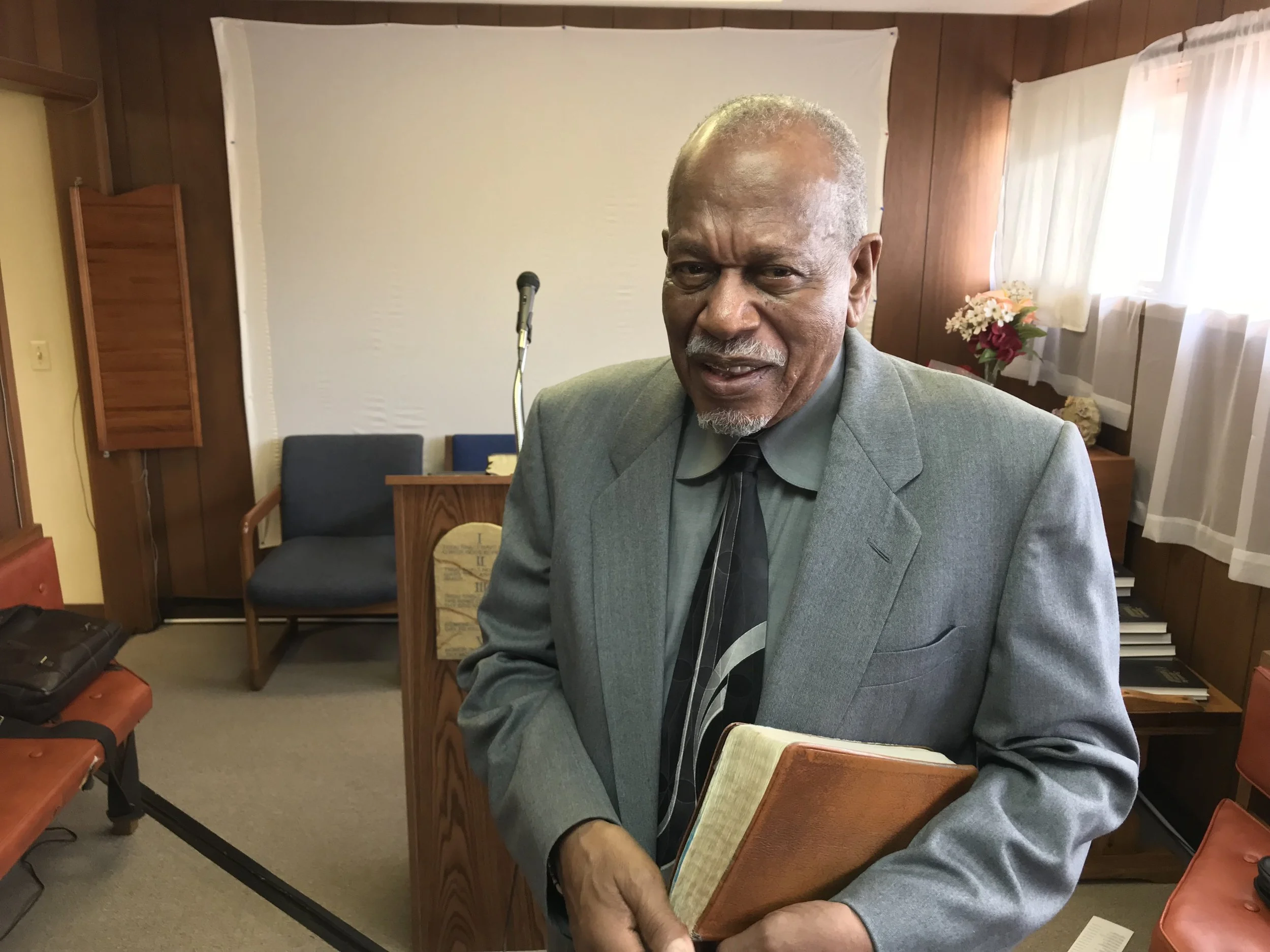
Elder Henry Boykin, of the Kenosha Seventh-day Adventist Church.
Last week, I had a visit with Fred Buchholz, who despite a prolonged stay at the hospital for rehabilitation, was acting as a literature evangelist. With a stack of tracts on the table next to him ("After the Storm" by Danny Shelton), he explained to me that while he was at the hospital, he was determined to pass as many of these out as he could. He also was sharing with them his own testimony about how God saved him from a life-threatening situation when he was a young man that, logically, he should not have survived. While the medical staff may have viewed him as the one who was broken and needed fixing, Fred knew that he had Christ and that true brokenness came from separation from Jesus. In that light, it was his goal to direct the physicians to an even greater Physician: One who can heal in their lives what medicine cannot.

Fred Buchholz, a Deacon the Raymond Seventh-day Adventist Church, at the hospital with tract in hand.
While there are many more examples of this kind of medical missionary, these two visits stand out in my mind. They've challenged me to be more open to and creative with ministry, even in areas of my life that I find taxing or uncomfortable--on a plane, at the hospital, standing in line at the DMV. This has caused me to ask the question: Am I bringing glory to God in everything I do, or are there some areas that are off limits because they're all about me? It's a needed challenge in all of our lives. How will you bring glory to God today, regardless of the circumstances?
- Pastor Zachary Payne
The Trinity vs. Hierarchy
One of the common themes that we circled around last month in our vespers talks and sermons on the Trinity is that there is no "greatest" in the Godhead. The idea of a Trinitarian hierarchy is an oxymoron. Jesus promoted servant leadership, and rejected ideas about "who will be the greatest in the kingdom" (Matthew 18:1-5). And when we see Him teaching servant leadership to His disciples--and saying things like "the last will be first and the first will be last" (Matthew 20:16)--this was simply an overflow of the servant leadership within the Trinity as each member of the Triune God takes turns in leadership, support, and submission when it comes to the plan of salvation, and all is done in love.
One of the common themes that we circled around last month in our vespers talks and sermons on the Trinity is that there is no "greatest" in the Godhead. The idea of a Trinitarian hierarchy is an oxymoron. Jesus promoted servant leadership, and rejected ideas about "who will be the greatest in the kingdom" (Matthew 18:1-5). And when we see Him teaching servant leadership to His disciples--and saying things like "the last will be first and the first will be last" (Matthew 20:16)--this was simply an overflow of the servant leadership within the Trinity as each member of the Triune God takes turns in leadership, support, and submission when it comes to the plan of salvation, and all is done in love. We also talked about how biblical marriage calls for love and submission of both spouses, instead of tyranny of any one partner--because this is a reflection of the love God has, both for humanity and within the Trinity.
The support for these ideas has already been laid down in previous talks/articles--This article does not seek to defend the ideas further, but to show why it matters so much that we turn away from any notion of Trinitarian hierarchy. And much of why it matters is wrapped up in an unfortunate view, which many call "headship theology."
What is headship theology? Here are some concepts from which it is drawn:
Ephesians 5:23 - The husband is the head of the wife even as Christ is the head of the church, his body, and is Himself its Savior.
Matthew 11:27 - All things have been handed over to Me by My Father . . .
These verses are wonderful and obviously represent scriptural truths. However, it is no secret that Bible truth can be twisted to say something it never intended to say.
Last month, we talked about the concept of a Trinitarian hierarchy: A Timeless (unreachable) God over Jesus, saints as mediators, Mary as head of Jesus, etc.
Protestants have created their own version of that in headship theology: Where the Father is over Jesus, Jesus is over the Church (whose leaders are men), men are over their wives, wives are over children, etc.
Now, don't misunderstand me: I don't mean to discount the Biblical view of Jesus’ role in the Trinity: He was sent by the Father, He submitted to the plan of salvation, the Father handed Him authority, etc. Nor do I mean to discount the Biblical view of household roles: While husbands and wives are to submit to each other (and there is an equality in that relationship), there is an understanding of head of household (not one of tyranny but of love and support). Let us also not forget the Biblical view of Christ as the Head and Savior of the church. However . . . When we start thinking along these lines of Trinitarian hierarchies too strongly, we begin to sanctify earthly hierarchies.
God is over angels, like He is over humans, because God created angels. Angels have different roles in heaven (Cherubim, Seraphim, Guardian Angels, Heavenly Host/Army, Archangel, etc.), but the only one who seemed to make a big deal out of this was Lucifer: Obsessed with hierarchy. He wanted to be more than he was: Not top angel, but God rather than angel.
Lucifer was envious and jealous of Jesus Christ. Yet when all the angels bowed to Jesus to acknowledge His supremacy and high authority and rightful rule, he bowed with them; but his heart was filled with envy and hatred. Ellen White, The Story of Redemption, p.14.
So yes, God is over all--angels and humans alike. There is a natural hierarchy where God is over all of His creations, but there is no hierarchy in the Trinity, as we explored in the sermon this month. The members of the Godhead have different roles, but they serve and love and submit to one another.
To be clear, before we move on, what I am saying is that the only biblical hierarchy is the one where God is over all of His creations. In the Trinity there is no hierarchy, and therefore on earth there is no hierarchy when it comes to the idea of "who will be the greatest in heaven" or even on earth. The Bible speaks of many hierarchies on earth, but these are merely descriptors of functional realities and not an expression of God's ideal for humanity. God created the first humans equal and, ideally, that's how it would have stayed, had it not been for sin.
Back to headship theology. It is important to understand these ideas, in part, because this is the route that many who oppose women in ministry have taken: Embracing a Trinitarian hierarchy in order to show that women should not be in ministry. With this statement, I don’t mean to take a stand on the idea of women in ministry: There may be other reasons to reject the ordination of women, but headship theology brings dangerous implications with it. To be clear: The point of this article is not to defend or disavow women in ministry, but to show that headship theology seems to have found a stronghold amongst those (not all, but many) who oppose the ordination of women.
An illustration: Lately, I've been reading the book The Lost Meaning of the Seventh Day by Sigve K. Tonstad. There is an illustration in Chapter 10 of this book, where Tonstad makes the connection between Nehemiah's willingness to use force to enforce the Sabbath (Nehemiah 13:21) and the Pharisees in the New Testament and their willingness to use whatever means necessary, including force, to silence Jesus and His supposedly unorthodox ways. Nehemiah had a good intention: To ensure that a people who recently came back from exile for disregarding God's commandments would start keeping the Sabbath holy. But sometimes, even with the best of intentions, our methods can be unfortunate and have long lasting negative impacts. This seems to be the case with headship theology. The intention is good: To preserve a biblical model of leadership, but because they fight so strongly for it, the method seems to overreach into an unhealthy realm.
Because of their resorting to headship theology, some unhelpful implications have arisen in our church, in some circles. First of all, a Trinitarian hierarchy can be problematic: If the Father is higher than Jesus and the Holy Spirit, are the two "lesser" members of the Godhead fully God or are they almost sub-gods compared to the Father (an issue not inherent in all headship theology, but definitely an issue Adventism today, as was discussed in a previous article). Further, if there is a Trinitarian pecking order, then hierarchies are a holy thing, and therefore we can claim biblical support for the establishment of hierarchies on earth. And with this, we are forced to ask the question: Who is the highest on that hierarchical ladder, and who is the lowest? Who is closest to God in that order? What follows are some historical problems when it comes to this train of thought.
Are men closer to God than women?
Hierarchical theology has led many a church leader to consider women as inferior to men. Observe these quotes by one of our favorite reformers, Martin Luther . . .
There is no dress that suits a woman or maiden so badly as wanting to be clever.
God created man with a broad chest, not broad hips, so that in that part of him he can be wise; but that part out of which filth comes is small. In a woman this is reversed. That is why she has much filth and little wisdom.
And who can enumerate all the ludicrous, ridiculous, false, vain, and superstitious ideas of this seducible sex? From the first woman, Eve, it originated that they should be deceived and considered a laughing-stock.
Because Luther would have had a hierarchical understanding of the Trinity, it led him to seeing an earthly hierarchy on earth. In his eyes, men were closer to God than women and therefore he felt comfortable saying and writing some very upsetting things regarding women. He also had issues with the way he viewed Jews, which I will not address at this time. Neither his views of women or Jews were unique to him, as many during his time (and also before him and even into our present time) had a view that said these groups were in some way inferior and further from God.
Are Christians closer to God than others?
With this question I don't mean to address actual salvational realities, such as Christ being the only one who can offer true salvation. In many ways Christians could be considered closer to God because they are the ones who follow Christ, the Savior. But this question does mean to ask: Just because you are a Christian (or because you call yourself one, or belong to a Christian church), does that mean God loves you more or that you have more access to salvation than anyone else? The answer is obviously "no." However, throughout history there have been examples of the Christian church using religion to set up a hierarchy: One where an in-group (whether it be Catholics or Calvinists or Lutherans, etc.) is excused to persecute and even kill an out-group (whether Muslims or Jews or Anabaptists, etc.) because that out-group is further from God. Examples of this include the Spanish Inquisition and even the Manifest Destiny philosophy of early American pioneers. Christians have, unfortunately, historically persecuted non-Christians because they felt they had the authority of being God's elect (read: highest/closest to God in the earthly hierarchy) and that somehow God would expect that the "heathens" be persecuted, even killed, if they did not convert. With that kind of flawed view of God and humanity, would you join the church? I would not. This is part of why it is so important to have a correct and biblical view of who God is and what the Trinity looks like.
Who is closest to God in the church?
There have as well, many times in history, been instances where even in the church, a hierarchy has developed. One of the most striking examples has been in the Roman Catholic Church. In the Middle Ages, Bibles used to be chained to the pulpit so that a common person could not steal it and read it for themselves. Common folks, after all, could not understand it like the priest could and would only get confused or pervert Scripture if they were given the chance to view it for themselves. So in this, we see a hierarchy that developed based on one's title and not purely as one's status as a child of God.
Theological hierarchies have developed as well: This is why we have the word "heretic." Not that there haven't been people with wrong theology in the past, but once the church branded a person as a heretic, it became ok to persecute them. This was evident in Calvin's church-state of Geneva, in which he violently persecuted those who strayed from his specific brand of Protestant reformation-theology (just as the Catholic Church would have persecuted him, if it had the chance). Even in early Puritan New England, there were many years where a person could not own land, vote, or even become a citizen of a community if they held any divergent theological beliefs from the town leaders.
And, of course, throughout history there have been dozens of examples of the wealthy and powerful being given more grace than the poor. The indulgences called for by the Roman Catholic Church (which ended up being an impetus for the Protestant Reformation) are one famous example of this. But has the tendency to treat the wealthy as somehow holier or more worthy of forgiveness departed from the church since then? Of course not. On the other hand, no one would make the claim that a rich person is closer to God than a poor person, but it seems easier for church leadership to let things slide when the perpetrator has donated much over the years than it is to forgive someone who has given little.
Is any race closer to God?
Our list would not be complete without addressing the issue of race in church history. The KKK was (and is) a very religious organization, which considers it a virtue to belong to the Nordic race, and the Protestant Christian faith. Therefore, those with dark skin, as well as Catholics and Jews are considered to be "lesser-than" in the eyes of a KKK proponent, and this idea has led to much violence and persecution against these out-groups.
Again, the Manifest Destiny philosophy of early Americans was not much different. Native Americans were seen as savages and not among the "elect" of God's people who crossed over to the New World from Europe. When the diseases they brought over killed many of the natives (because their immune systems weren't used to European germs), they saw it as divine displeasure of these natives and divine providence that they--the new settlers of the land--were chosen by God to repopulate America. This further is evidenced in their continual forcing-westward those natives who survived the diseases.
In the Mormon Church, racism has only recently been denounced. In the Book of Mormon, the Hebrew tribe of Lehi comes to America and after their father passes away, the older brother Laman is jealous and violent toward his younger brother Nephi. Because of his evil and jealousy, God eventually curses Laman and his descendants with a physical mark of dark skin, to differentiate them from the pure Nephi and his family. As the story goes, the dark-skinned Lamanites eventually destroy the fair Nephites, which has traditionally been the Mormon church's explanation for why the Native Americans all had a darker skin tone than the Europeans who came later--they were the descendants of the evil Laman, and therefore not part of God's chosen elect. With this historical backdrop, racism was an institutional feature of the Mormon church up until recently, when the church made some large-scale reforms in order to appeal more broadly to today's American audience.
Conclusion
In Christ Jesus you are all sons of God, through faith. For as many of you as were baptized into Christ have put on Christ. There is neither Jew nor Greek, there is neither slave nor free, there is no male and female, for you are all one in Christ Jesus. And if you are Christ's, then you are Abraham's offspring, heirs according to promise. Galatians 3:26-29
The only way for this verse to become reality in our lives is to stop seeing the Trinity as a hierarchy and to start seeing it for the mutually loving, supportive, and submissive collective that it is. The God we serve determines the person we are, so if we serve a God that has a pecking order (The Father being over the Son and the Son being over the Spirit and the Spirit being over the men of the Church, etc.) we will promote an earthly pecking order. Always. If we ever use our race, our gender, our position, our socioeconomic, or our religion (etc.) to lord over others, we are not serving the God of the Bible.
This is how we achieve equality and unity on earth: By a correct, biblical view of God, and by proxy a correct, biblical view of humanity.
Before we end, the question must be asked: Will we ever achieve this? Is our goal a utopia of equality and unity and peace?
For as were the days of Noah, so will be the coming of the Son of Man. Matthew 24:37
Biblically, things don't seem to get better from here to the Second Coming. But we can still work to reach as many as possible for the kingdom before the end comes. Let us not allow earthly hierarchical thinking get in the way of reaching as many people as possible for Jesus. We want to be prepared when His Day comes, and we want to bring as many people with us as possible.
- Pastor Zachary Payne
God's Brand
Think about it: When we see a white robe, we think purity, salvation, and heaven. When we see a cross, we think of Christ’s sacrifice, his life, and what it means to follow him. God stamps his name upon the heads of the 144,000 in the book of Revelation, to show others that they are of his brand. Branding is all over in the Bible, from God giving Cain a mark that let others know to back off, to Jesus comparing the Kingdom of Heaven to a mustard seed. Even titles like “Christian” and “Adventist” carry specific brand imagery to onlookers.
God is into branding.
Not like the marking-your-cattle-with-a-hot-iron kind of branding. But the modern, business-world kind of branding: Using strategic words and imagery in order to convey a specific message to observers.
Think about it: When we see a white robe, we think purity, salvation, and heaven. When we see a cross, we think of Christ’s sacrifice, his life, and what it means to follow him. God stamps his name upon the heads of the 144,000 in the book of Revelation, to show others that they are of his brand. Branding is all over in the Bible, from God giving Cain a mark that let others know to back off, to Jesus comparing the Kingdom of Heaven to a mustard seed. Even titles like “Christian” and “Adventist” carry specific brand imagery to onlookers.
But a brand is not an image or a logo. A brand is not a word or a slogan. Those things are part of a brand and they are known as “brand identity;” but brand does not equal brand identity. An organization’s brand, boiled down to its core essence, is its reputation.[i]
For example, when we think of Walmart’s brand identity (a smiley face, the phrase “Rollback,” etc.), we might associate the brand positively with a reputation of low prices or we might associate it negatively with a reputation of overseas sweatshops and poor employee compensation, depending on our experience with the organization. When we think of Chicago’s brand identity (a picture of their skyline, the phrase “The Windy City,” etc.), we might associate the brand positively with a reputation of sports, shopping and concerts or we might associate it negatively with a reputation of crime and terrible traffic, depending on our experience with the city. A brand identity–the obvious elements like a name, a logo or a phrase–conveys in an instant the entity’s reputation to the observer.
We find this sentiment of brand = reputation in the 3rd Commandment, where God tells his people not to take his name in vain. We often assume here that God is asking that we don’t use his name in swear words or in common colloquialisms, and he very well may not want us to do that. But this commandment is saying so much more. This is God telling his people that he is very serious about his brand (reputation) and we should make sure we’re committed to it as much as he is before going off and representing him to the world.
This brings us to a concept known in the business world as personal branding. Personal branding says that we each individually represent something to those who observe us. And if what we personally represent is not congruent with the organization we belong to, we have the ability to cast our brand (reputation) upon the organization’s brand (reputation), for better or for worse.
Consider the following quote from a brand mentor/image consultant:
“For any organization its reputation is communicated by its employees. The customers perceive the brand of the company by its employees.”[ii] Of course, in a religious setting this principle wouldn’t just apply to “church employees” but to all Christians everywhere. As “employees” (read: members, believers), we convey God’s reputation to the world. That’s heavy, but it’s true.
By the way, what is God’s brand?
“Anyone who does not love does not know God, because God is love.” 1 John 4:8
Ellen White echoed the above sentiments of God’s brand and our personal representation of it when she wrote, “The strongest argument for the Gospel is a loving and loveable Christian.”
Unfortunately, there have been many Christians and non-Christians who have misrepresented his brand over the years, and now we find ourselves in a world where people don’t really know what to think when they hear the word “God.” Rob Bell realized this conundrum and wrote a book about it called What We Talk About When We Talk About God.
In other words, the God brand has suffered to the point that many don’t know anything about him, or if they do they want nothing to do with him.
Back to the 3rd commandment: If we can’t be serious about living our lives the way God asks us to, and if we are going to misrepresent who he is in his love and goodness and glory, then maybe we should not call ourselves his people. We’ve all met a fellow Christian who acted in a hypocritical way and made us think: Yikes! He’s giving us Christians a bad name. And, let’s be real, we’ve all been that hypocritical person who gave Christianity a bad name at some point in our lives (in fact, even the act of calling someone else a hypocrite is hypocritical, unless it’s Jesus doing the name calling).
This is not to say that if we ever act foolishly (which we all do from time to time) we cannot call ourselves Christians. It simply means that we need to pay close attention to the God we love, worship, and represent, and ask ourselves this question: When others see us, are we upholding God’s brand or are we sullying it?
We may be dealing with spiritual and religious matters, but these are mainstream business principles.
My challenge is one, not of condemnation, but of self-evaluation: Are you accurately representing God’s brand to observers?
As stated above, God’s brand has suffered. Let’s change that! Let’s bring his brand back by showing the world the most powerful brand-testimony they’ve ever seen: Christians who love and want to serve others, as Christ has loved and served us. I’m a firm believer that it is our life’s work to tweak our personal brand until it is the very brand of God, so that when others look to us, they see the God we represent and want to serve him as well.
“Therefore, we are ambassadors for Christ, God making his appeal through us. We implore you on behalf of Christ, be reconciled to God.” 2 Corinthians 5:20
- Pastor Zachary Payne
[This post was originally published at www.thehaystack.org]
__________
[i] Randy Shattuck, “The 6 Elements of Building a Strong Professional Services Brand,” http://www.peterhhelmer.com/wordpress/wp-content/uploads/The-6-Elements-for-Building-a-Strong-Professional-Services-Brand.pdf.
[ii] Ruchi S., “How Organizations Benefit from Personal Branding,” https://www.linkedin.com/groups/How-Organisations-benefit-from-Personal-4579790.S.5937474118193532930.
Answered Prayers
In 2011, I worked as a counselor at Camp Wakonda in Wisconsin for the first time. All week long, I watched as a group of girls laughed, learned and grew spiritually. Halfway through the week, I learned that Vanessa [actual name withheld], one of the young ladies in my cabin, had a rocky relationship with her father, and I was asked to give her words of encouragement.
In 2011, I worked as a counselor at Camp Wakonda in Wisconsin for the first time. All week long, I watched as a group of girls laughed, learned and grew spiritually. Halfway through the week, I learned that Vanessa [actual name withheld], one of the young ladies in my cabin, had a rocky relationship with her father, and I was asked to give her words of encouragement.
“God, this isn’t funny. Who am I to talk to this girl about how to get along with her own father when I only speak to mine on Christmas and Father’s Day?” I asked.
The challenge plagued me all week. I had no clue what to say to Vanessa. Friday night rolled around. This was the night, the moment every staff member waited and worked for all week. We were going to ask the campers to take the most important step in their life, to invite them to give their heart to Jesus and allow Him to lead their life.
I still hadn’t opened the “Pandora’s box” with Vanessa, and I only had one more day in which to do it. As I spoke with all of my girls and handed them the commitment cards, they began to make their decisions. As they handed the cards back, I noticed Vanessa’s was missing.
On the walk back to our cabin, she spoke. “I want to get baptized, but I’m afraid my dad won’t let me. He’s not a Seventh-day Adventist.”
I told her the very truth I wish someone had told me when I faced the same dilemma at her age. “Vanessa, I would be lying to you if I told you that once you choose to follow God your life will get easier. It won’t; it will get a little harder before it gets better. But this I can promise, and I live by this truth: God will use you to do amazing things. Once you give your life to Him, there will be so many surprises and you get to be a part of the story. Stay close to Him and nothing, not even a father that doesn’t agree with you, will stand in God’s way. Trust Him who loved you first.”
I left Vanessa alone to make the decision of a lifetime and prayed with all my heart that God would show her His mighty hand.
Much sooner than I would have liked, camp ended and real life began. Every once in a while, I took time to pray for my campers and hoped someone out there was praying for them, too.
The next summer Vanessa was, once again, in my cabin. She said, “I have to tell you something.” I noticed the glow and nervousness on her face as she told the story and sang a new song. “Well, do you remember how I was scared of getting baptized last year? Well, I did. And I sang this song. My dad was there. Now he goes to church with me sometimes. He told me he cried when he heard me singing.”
My simple, every-once-in-a-while prayers were heard and answered. I hope Vanessa’s father is the first of many who sees her new life and decides that if a tween camper can have this kind of faith, nothing should stand in the way of letting them do the same.
- Elkid M. Álvarez-Maldonado
[This article was originally published in the August 2013 issue of the Lake Union Herald: http://luc.adventist.org/Herald%20Site%20PDFs/Vol105-08.pdf]
The Trinity and Marriage
We find, throughout scripture, that God gives us earthly institutions as projections of heavenly realities. The tabernacle and temple were given in the Old Testament as a projection of the heavenly sanctuary. The Ten Commandments are given as a projection of God's character. The Ark of the Covenant is an earthly projection of God's heavenly throne. In the same way, marriage is given as a projection of God's Trinitarian unity. And if this is the case, then the earthly institution of marriage is supposed to paint a picture of God, and it must be guarded. Unhealthy and unbiblical marriage means a distortion of God's image in marriage and a misrepresentation of Him.
Therefore a man shall leave his father and his mother and hold fast to his wife, and they shall become one flesh. Genesis 2:24
Hear, O Israel: The LORD our God, the LORD is one. Deuteronomy 6:4
Both of these verses use the word אֶחָד (echad), which means one. But this is not the numeral one, which is denoted by א (aleph, the first letter of the Hebrew alphabet, like our letter "A"), but it is a coming together of multiple components--a unity of multiples.
It is this word that links, grammatically and biblically, the ideas of the Trinity and marriage together. God's unity is described as "echad" and the concept of unity in marriage is described as "echad."
We find, throughout scripture, that God gives us earthly institutions as projections of heavenly realities. The tabernacle and temple were given in the Old Testament as a projection of the heavenly sanctuary. The Ten Commandments are given as a projection of God's character. The Ark of the Covenant is an earthly projection of God's heavenly throne. In the same way, marriage is given as a projection of God's Trinitarian unity. And if this is the case, then the earthly institution of marriage is supposed to paint a picture of God, and it must be guarded. Unhealthy and unbiblical marriage means a distortion of God's image in marriage and a misrepresentation of Him.
Divorce, adultery, homosexuality, marital tyranny and other sexual and marital failings have the ability to distort the original intent of marriage and sex--which is to teach us something about God. How is this so? Marriage imagery is found throughout the Bible, and in this imagery Christ is the husband and the church is the bride. If we see ourselves, in the church, as Jesus' bride, then the metaphor starts to come to life in very real and relevant ways.
Marriage is supposed to represent a bond that can never be broken between God and His people (What God has joined together, let not man separate. Matthew 19:6), so when divorce happens it distorts that picture. We see divorce and think: Love doesn't last forever, lovers leave each other. Will God leave us? On the contrary, Jesus tells us that he will never leave us nor forsake us (Joshua 1:5). If that is the case for Jesus, the best way to represent Him in our marriages is to stay together, and not just unhappily, but full of love and joy and passion for each other. I realize this is an ideal, and do not mean to condemn those who have had been through the unfortunate experience of divorce, but this is how marriage can best reflect the image of God. The members of the Godhead can never be separated, Jesus will never leave us, and we should never leave our spouses.
Adultery follows along similar lines as the explanation for divorce above, but there are many passages in which adultery is related to the spiritual realm. God, multiple times in the Old Testament and the New alike, refers to those who forsake Him, the one true God, as adulterers. The book of Hosea is a story of a man who marries a prostitute to prove a point: God loves us even when we continue to cheat on Him and leave Him for other lovers (religions, gods, beliefs). So the actual act of adultery paints a picture of one who leaves their "first love" (God), and reconciliation from that adultery represents God's forgiveness and selfless love. He loves and forgives us no matter what, even when we cheat on Him. The members of the Trinity will never depart from or cheat on each other, Jesus will never leave us for others, and in order to let our marriages represent Him, we have to guard ourselves from adultery.
Homosexuality might be one of the more complicated ideas in the mix, but the Bible calls it a sin in multiple places (Leviticus 18:22, for example), and there must be a reason that God wants to protect marriage from it. Perhaps one of the best explanations I have come across is the idea that Marriage is a oneness (echad) of multiples, a coming together in light of diversity. The Father, Son and Holy Spirit are equal but have different roles. Though we like to focus on the equality these days (and male and female are equal), we sometimes forget that men and women have different roles as well. God gave Adam a helper in the garden (Genesis 2:18) because He knew man was incomplete without woman and woman was created to compliment and help man. So the idea of homosexuality puts the kibosh on this idea. Marriage is between man and woman because each has unique roles to play in a marriage relationship, the Trinity is between three different persons in equality.
Marital tyranny is another, very common form of distortion of the image of God. The Bible tells us that women should submit to their husbands (Ephesians 5:22), and men have run with this as an excuse to have complete control over their wives. But directly following, we find that men are to love their wives enough that they would be willing to give their lives for them (Ephesians 5:25)--and the reason why? Because Christ gave Himself up for the church. The way we treat our spouses, even if we don't get divorced or commit adultery, can paint either a positive or very negative picture of how God loves us. Within the Trinity, there is an eternal love and unselfish support and submission (as we learned in our Sabbath sermon this month), Jesus loves us completely and came to lead as a servant and not as a tyrant, and if we want to reflect our God in marriage, we must treat our spouses in fairness, love, and equality.
So what's the point of all of this? The Bible defines marriage very specifically for a reason: It represents the Trinity and it is used as a metaphor for salvation and our relationship with God. When we start to tamper with what the Bible says about marriage, we start to tamper with the way we reflect God to the world. Sure, men can marry men; sure, divorce and adultery are earthly realities; men and women alike rule over their spouses. But if we get back to what the Bible says about marriage, we get back to a method of showing the world what God is like through our life, our relationships, our marriages.
If we want a healthy picture of God, we have to get back to a healthy, biblical understanding of marriage. And on the other hand, if we want healthy, biblical marriages, we have to study the character of God and come to a full understanding of who it is we serve. The God we serve directly affects the way we are as a Christian and as a spouse.
- Pastor Zachary Payne